
Part 7 of Building Software Support for a New AI Accelerator. Numerical validation spans instruction behavior, operator accuracy, gradients, model quality, and training convergence. Each level needs explicit acceptance criteria.
Numerical acceptance criteria
Precision, rounding, accumulation order, fused operations, denormal handling, approximation functions, and parallel reduction order all affect floating-point results. Two accelerator implementations can satisfy the same contract while differing in low-order bits. Agreement on a small test can still conceal divergence over a long training run.
The platform must define acceptable behavior per workload and level. An elementwise operator may use an absolute and relative tolerance. A reduction may need an error bound that grows with size. A classifier may be judged by task metrics. Training requires loss curves, gradient statistics, and convergence over enough seeds to separate a backend error from ordinary stochastic variation.
Dtype semantics
The dtype contract covers encoded values and operation behavior:
- Encoded range and special values.
- Input conversion and rounding mode.
- Multiply, accumulation, and output precision.
- Saturation or overflow behavior.
- Treatment of subnormals, NaNs, and infinities.
- Reduction order and intermediate precision.
- Transcendental approximations.
- Whether behavior changes under a fast-math mode.
Low-precision matrix formats often multiply in one format, accumulate in another, and scale at a tensor, channel, block, or tile granularity. Framework dtype, checkpoint representation, compiler types, kernel layouts, and hardware instructions must describe the same scheme.
Autograd backend requirements
PyTorch’s autograd engine records a graph and schedules derivative work. The accelerator backend supplies correct forward and backward operators, saved-tensor semantics, stream ordering, gradient dtypes, and integration with compiled backward graphs.
There are several ways an operator can acquire derivative behavior:
- A derivative formula expressed in existing PyTorch operations.
- A separately registered backward implementation.
- A custom autograd function.
- A compiler-generated backward graph through AOTAutograd.
Test each path. In-place operations and views are especially sensitive because version counters and aliasing determine whether saved values are valid. Higher-order gradients add another level of operator coverage.
An inference-only product can exclude gradients from its support contract and reject backward use with a clear error. PyTorch enables autograd by default, so the backend must define dispatch behavior for forward-only workloads as well.
Automatic mixed-precision policy
AMP chooses which operations use lower precision and which stay in or promote to
FP32. The policy balances throughput, range, and numerical sensitivity. PyTorch’s
accelerator integration exposes casting categories through
AutocastPrivateUse1, along with the dtypes supported by the device.
Training adds gradient scaling to avoid underflow. The complete path includes scale updates, non-finite detection, optimizer interaction, distributed gradient reduction, and checkpoint state. Inference still needs autocast policies that agree with model conversion and kernel support.
The policy should be versioned and testable. Changing an operation from FP32 to lower precision can improve a benchmark and alter model quality.
RNG and determinism
Random-number behavior touches initialization, dropout, sampling, data loading, stochastic rounding, and randomized algorithms. A backend needs generators, seeding, state save and restore, stream-safe consumption, and defined behavior under graph capture or recomputation.
Define determinism for a named build, device, algorithm set, and seed. PyTorch documents that complete reproducibility is not guaranteed across releases or platforms. Deterministic algorithms may be slower, but they reduce debugging and regression cost.
The backend must also identify known nondeterministic operators and honor the framework mode that requests deterministic alternatives or errors.
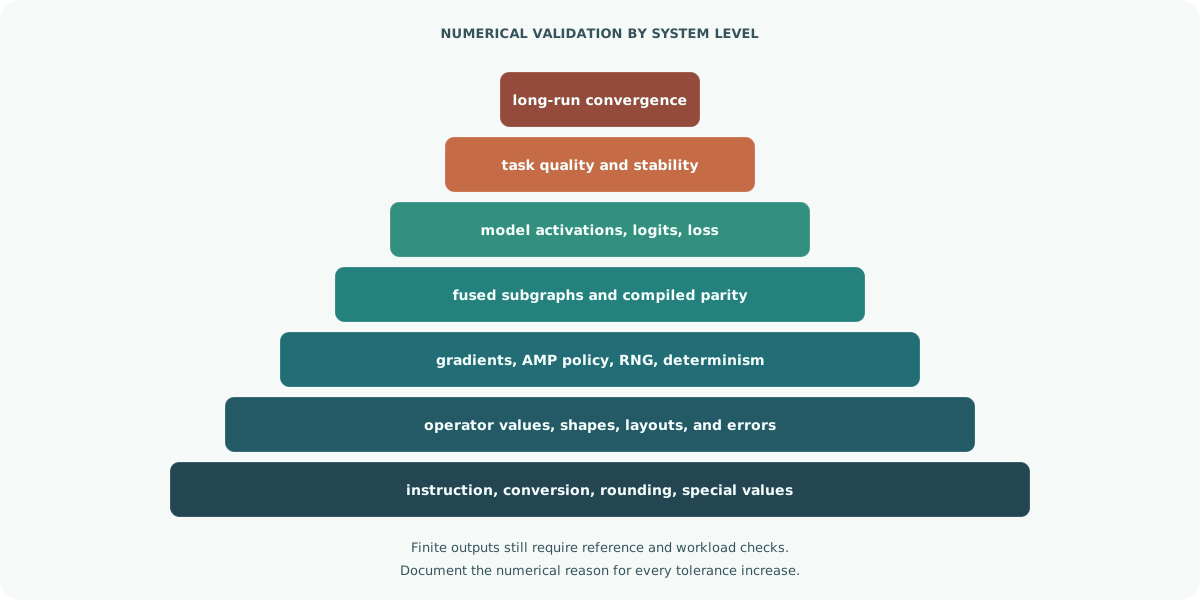
Validation across system levels
Instruction and conversion tests. Exercise rounding boundaries, overflow, special values, scaling, and every promised accumulation path.
Operator reference tests. Compare values, shapes, strides, errors, and fallback state across dtypes and layouts. Include large reductions, adversarial inputs, and random values near zero.
Gradient tests. Use analytical comparisons and finite differences where
appropriate. PyTorch provides gradcheck and gradgradcheck, with care required
for low precision and nondeterministic functions.
Fused-subgraph tests. Compare compiler fusion and tuned library paths with an unfused reference. Many numerical changes enter through reassociation or reduced intermediate precision.
Model checks. Compare layer activations, final logits, loss, generated tokens, or task metrics. Layer-by-layer capture localizes the first divergence.
Long-run qualification. For training, compare convergence, stability, and quality across seeds. For serving, run long contexts, sustained batching, cache pressure, and repeated sampling.
Tolerance review and failure artifacts
Record the reason for each tolerance. Valid reasons include dtype precision, reduction length, approximation error, stochastic behavior, or an accepted fast algorithm. Increasing a tolerance until a test passes loses the distinction between expected numerical variation and a broken kernel.
Failure artifacts should retain the exact input, seed, device and software builds, algorithm identity, compiler graph or IR, and the first mismatching values. Add minimized reproducers to the permanent regression suite.
Numerical modes and performance tradeoffs
Higher-accuracy or deterministic algorithms can cost throughput or memory. Deterministic reductions may serialize work. Higher-precision accumulation consumes resources. Fast transcendental approximations trade error for latency. The platform should expose these choices through explicit modes or documented policies. Any build flag that changes numerical behavior must be part of the published configuration.
Every benchmark artifact must state its numerical mode so performance comparisons use equivalent quality requirements.
Previous: The Graph Compiler. Next: Scale-Up and Scale-Out. Series index.
Sources: PyTorch AMP integration; PyTorch reproducibility; Gradcheck mechanics; Extending PyTorch; PyTorch compiler FAQ.