
Part 1 of Building Software Support for a New AI Accelerator. Before discussing drivers or kernels, define what users are being promised.
Support claim
The phrase “the accelerator supports PyTorch” refers to a large engineering program.
A user reads that sentence as behavioral compatibility. They expect tensors to move to the device, familiar models to run, errors to identify their cause, saved state to round-trip, mixed precision to behave predictably, and performance to improve without a private rewrite of the model. Training users add gradients, optimizers, distributed execution, and convergence. Inference users add model loading, quantization, KV-cache capacity, batching, latency, and service stability.
An accelerator program needs a support contract that engineering teams and users can test.
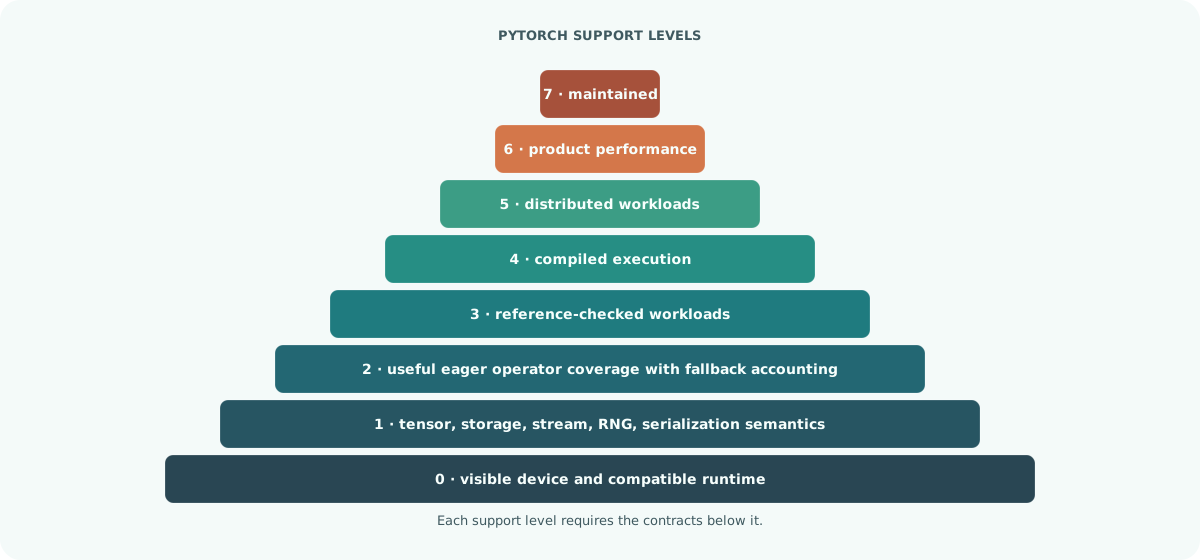
Eight levels of support
Level 0: device discovery and compatibility. The package imports, the runtime finds a compatible driver, devices can be enumerated and selected, and initialization fails with a useful message when the stack is incompatible.
Level 1: tensor semantics. Allocation, views, strides, copies, storage offsets, dtype conversion, scalar extraction, serialization, streams, events, and random-number state obey their contracts. Model demonstrations depend on these primitives.
Level 2: eager operator coverage. A stated operator set runs on the device for declared dtypes, shapes, and layouts. Native implementations, composites, decompositions, and fallbacks are reported separately. Unsupported cases fail without corrupting state.
Level 3: workload correctness. Representative models execute end to end without unintended host fallback. Activations, logits, losses, or task metrics match a reference within a stated tolerance. Memory use and initialization are bounded.
Level 4: compiled execution. Graph capture, metadata propagation, dynamic shapes, mutation, custom operators, code generation, caching, and recompilation behave on real programs. The compiled result matches eager execution and produces a useful speedup after compilation cost is accounted for.
Level 5: distributed execution. Collectives, asynchronous progress, topology discovery, sharded tensors, parallel training or inference, checkpointing, timeouts, and rank failure have a qualified path.
Level 6: performance qualification. Published results name the model, input distribution, precision, batch or concurrency, hardware, power mode, driver, framework, compiler options, warm-up, measurement window, and fallback state. Regressions are caught before release.
Level 7: maintained compatibility. Packages install on promised systems, compatibility rules are documented, profiler and diagnostic tools work, security and reliability updates ship, and a supported model retains a maintained execution path after a framework upgrade.
Backend paths for operator coverage
PyTorch currently documents more than 3,500 built-in operators when related variants are counted. Those operators form the public API surface. A backend can cover that surface through several implementation paths:
| Path | Coverage provided | What must stay visible |
|---|---|---|
| Native kernel or vendor library | target performance | qualified shapes, layouts, dtypes, algorithm selection |
| Composite implementation | reuse of existing operators | performance and semantic dependence on the component ops |
| Compiler decomposition | smaller primitive set | graph-only availability and decomposition stability |
| Host fallback | early functional coverage | transfer, synchronization, and performance cost |
| Explicit rejection | honest boundary | actionable error and capability query |
PyTorch’s accelerator documentation recommends starting with foundational storage, view, copy, and fallback operations, then expanding native coverage. Fallbacks must be reported separately because they can preserve results while invalidating device latency and throughput measurements.
A machine-readable support matrix
A support entry records the full contract:
operation: aten.softmax.int
device: accelerator generation 2
dtypes: fp32, bf16
ranks: 2 through 5
axis: any valid axis
layouts: contiguous; strided input through decomposition
execution: native for last-axis contiguous, composite otherwise
numerics: stated atol/rtol and accumulation mode
compile: eager and dynamic-shape compiled paths
autograd: first-order backward qualified
fallback: forbidden in performance runs
evidence: test suite, framework build, driver build, device stepping
Generate the matrix from tests and runtime capability data where possible. The resulting artifact can block a release, feed compiler legality checks, guide model placement, and explain host execution.
Failure behavior and compatibility
The contract also specifies behavior for exhausted memory, kernel faults, cyclic stream dependencies, incompatible drivers, and missing collective ranks. If the runtime converts all of those into “device error,” the user cannot distinguish an application error from a node failure.
The error path should preserve cause across layers:
hardware event -> firmware record -> driver status -> runtime error
               -> framework exception -> profiler/trace correlation
Recovery is equally specific. Some faults can fail one operation. Others poison a queue, context, device, node, or complete distributed job. The framework must know which state can be reused. Reusing undefined state after a device fault risks silent corruption.
model.to(device) acceptance criteria
The call exercises device discovery, parameter and buffer copies, allocation,
dtype handling, module-specific state, serialization assumptions, and custom
operators. The following forward pass exercises dispatch, kernels, streams, RNG,
numerics, and memory lifetime. torch.compile adds capture, metadata, lowerings,
guards, code generation, and cache identity. Distributed execution adds failure
paths on other processes and machines.
The implementation plan consists of the lower-level contracts required to preserve that simple interface.
Support-contract exit criteria
Before hardware design work begins, the program needs answers to these questions:
- Which support level is promised for each release?
- Which workloads define success?
- Which behaviors are native, decomposed, or falling back?
- How are numerical tolerances chosen?
- Which failures invalidate a context or device?
- What compatibility window is supported?
- Which artifact proves each claim?
Next: The Hardware-Software Contract. Series index.
Sources: PyTorch accelerator integration; PyTorch operator registration; torch.accelerator; PyTorch profiler integration.