
Part 5 of Building Software Support for a New AI Accelerator. Kernel libraries map supported operators to the algorithm variants needed to use the accelerator efficiently across workload shapes.
Workload bottleneck classification
Kernel libraries cover matmul, convolution, attention, norm, softmax, reduction, sort, gather, scatter, and elementwise math. Each operator maps to several algorithm families whose performance varies with shape, dtype, layout, sparsity, batch size, cache state, and hardware generation.
A large square matrix multiplication can fill matrix units efficiently. A decode-time matrix-vector product may spend most of its time reading weights. These cases require different algorithm variants for the same mathematical operator.
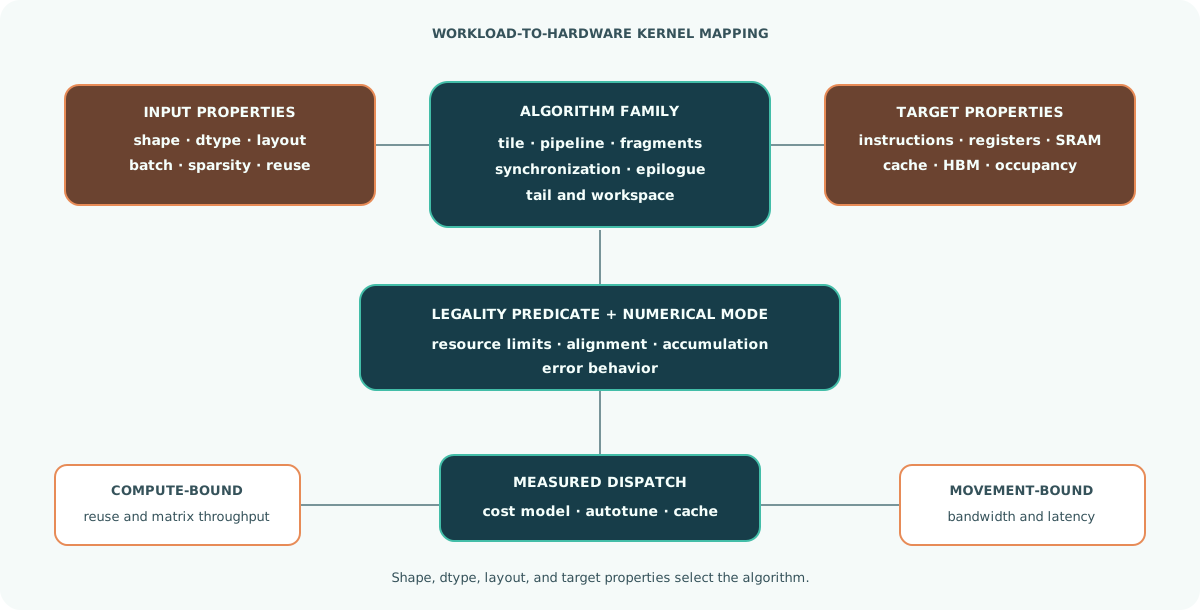
Arithmetic intensity and initial performance bounds
Arithmetic intensity is useful work per byte moved from a chosen level of memory. If a kernel performs little arithmetic for every HBM byte, memory bandwidth bounds it before peak compute matters. If it reuses each byte many times, instruction throughput may dominate. The boundary changes with cache residency, fusion, tile size, and batch.
The roofline model supplies an initial bound. Real kernels also pay for instruction issue, address calculation, synchronization, register spills, bank conflicts, occupancy loss, launch overhead, and tail handling. The model helps identify memory-bound workloads before tuning matrix-instruction throughput.
Tiling and resource use
A high-performance kernel partitions work so that data is reused near the compute units:
- A grid assigns output regions to workgroups or blocks.
- Threads or lanes cooperate on a tile.
- Data moves from global memory into registers or local SRAM.
- Matrix or vector instructions consume fragments.
- Partial results accumulate and are transformed or stored.
Tile choice balances reuse against resource pressure. Larger tiles can reduce global traffic and increase matrix-unit efficiency while consuming registers and SRAM. Resource use can reduce resident workgroups, expose latency, or make the kernel illegal. The best tile also depends on transpose flags, alignment, dimensions, and the instruction shapes exposed by the chip.
Kernel teams need an accurate resource model from hardware and compiler teams. Resource reports should include allocated register count and the source values responsible for spills.
Algorithm families and dispatch
A production matrix library holds multiple families: tiled matrix multiplication, small and skinny cases, batched forms, grouped forms for MoE, sparse variants, quantized paths, and fused epilogues. Attention libraries split prefill from decode, causal from bidirectional, dense from paged KV, MHA from GQA or MLA, and often split again by head dimension and hardware generation.
Dispatch selects among those families using a capability predicate and a cost model. Some choices can be made statically. Others are autotuned on representative inputs and cached. The tuning key must include every property that changes legality or cost. Tuning must stay off the production request path.
Dispatch itself has a cost. Creating a library handle, constructing descriptors, consulting a heuristic, searching algorithms, or missing a tuning cache can dominate a small operation. Libraries should expose the selected algorithm and measure cold setup, warm selection, and kernel execution separately. A valid cache key includes the shape, layout, dtype, workspace limit, target, numerical mode, and any stream or capture state that changes validity or cost.
Low-precision storage, conversion, and execution
Low-precision support spans instructions, storage, scaling, conversion, accumulation, framework integration, checkpoint handling, and validation:
- Storage and interchange formats.
- Scale representation and granularity.
- Quantize, dequantize, and conversion kernels.
- Accumulation and output precision rules.
- Calibration or training support where required.
- Fused consumers that avoid materializing expanded values.
- Reference tests for saturation, subnormals, NaNs, infinities, and rounding.
- Checkpoint loaders and framework dtype representation.
Block-scaled formats add layout constraints that can reach model conversion, distributed sharding, and kernel tile shape. Conversion overhead can erase the instruction-level gain.
Irregular and shape-dependent operators
Model execution also depends on indexing, sorting, top-k, segmented reductions, scatter, sampling, masking, and shape manipulation. These operations are often sensitive to rank, stride, dynamic sizes, and atomics. They frequently determine model coverage and can introduce hidden device-to-host synchronization.
Sparse MoE adds token routing, permutation, grouped expert computation, and result combination. The matrix work may be efficient while bucketing or all-to-all dominates. Kernel qualification must measure the subgraph as well as its largest GEMM.
Fusion legality and profitability
Fusing adjacent operations can keep intermediates in registers or SRAM, remove launches, and expose algebraic simplifications. It can also increase register pressure, duplicate work, reduce scheduling freedom, or create a large family of specialized kernels.
A fusion decision requires legality and profitability tests. Legality covers aliasing, mutation, numerical order, synchronization, and device limits. Profitability compares saved movement and launches with resource growth and lost reuse. The graph compiler usually owns the decision; kernel libraries provide reusable templates and primitives for the candidate implementations.
Kernel performance qualification
Microbenchmarks should report achieved bandwidth or operations, problem shape, dtype, layout, warm-up, clocks or power mode, and algorithm. End-to-end tests add framework and compiler versions, transfers, compilation, fallback state, and model quality.
The regression system should retain distributions across favorable and awkward cases:
- Common production shapes.
- Awkward tails and small batches.
- Cold and warm caches.
- Cold and warm library dispatch, including handle and descriptor setup.
- Contiguous and promised non-contiguous layouts.
- Concurrent compute and communication.
- Long runs that expose throttling or fragmentation.
Evaluate optimizations against the workload distribution. A benchmark gain that slows that distribution fails product performance criteria.
Kernel-library acceptance criteria
Each public kernel path should have:
- A legality predicate.
- Defined numerical behavior.
- Workspace and synchronization requirements.
- An algorithm or tuning identity visible to profiling.
- Reference and stress tests.
- Performance coverage over its intended region.
- A fallback or error for inputs outside that region.
Previous: Tensors, Dispatch, and Operators. Next: The Graph Compiler. Series index.
Sources: CUDA Programming Guide; AMD CDNA architecture; Triton language and compiler; NVIDIA NCCL documentation.