
Part 6 of Building Software Support for a New AI Accelerator. Graph compilation captures PyTorch programs, preserves their observable behavior, and lowers them through staged representations into legal device code and memory operations.
Graph-level optimization
Eager PyTorch executes operators as the Python program reaches them, which supports interactive programming and debugging. Separate launches, materialized intermediates, local layout choices, and per-operator memory planning can limit performance.
Compilation optimizes a graph region across operator boundaries. It can fuse work, specialize to useful facts, choose layouts jointly, reuse memory, overlap transfers, and generate kernels for combinations absent from a static library. Every transformation must preserve Python and PyTorch semantics.
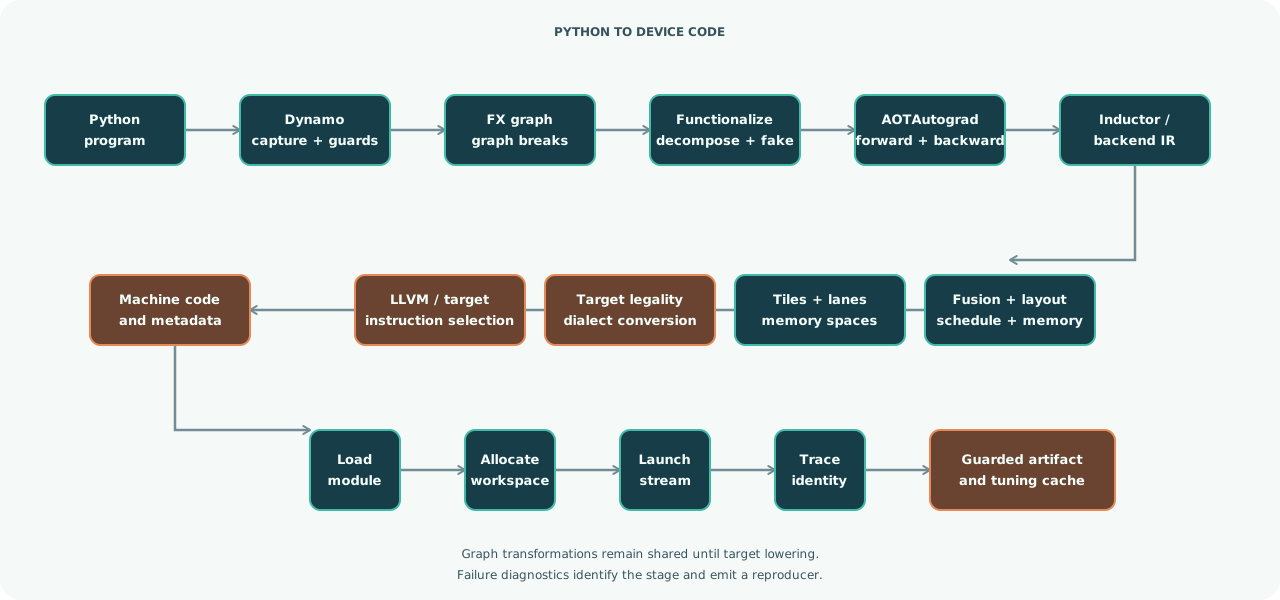
Graph capture and guards
TorchDynamo observes Python execution and extracts FX graph regions. The compiled result is guarded by assumptions about Python values, tensor properties, module state, and other facts used during capture. When a guard fails, the system may compile another version. Unsupported behavior can create a graph break, run in Python, and allow capture to resume later.
Graph coverage varies at runtime with the inputs, guards, graph breaks, and cache state. An accelerator backend needs tooling that reports each of these.
Dynamic shapes add symbolic dimensions and constraints. Static specialization can improve code quality and may trigger repeated compilations. Fully dynamic lowering can limit tiling, vectorization, or library selection. Specialize facts that improve performance and keep workload-varying dimensions symbolic.
Graph normalization before target lowering
Captured programs still contain mutation, views, composite operators, and training semantics. Compiler stages normalize these behaviors:
- Functionalization represents mutation in a form suitable for graph transforms while preserving observable behavior.
- Decompositions express broad operators through a smaller primitive set.
- Fake or metadata execution propagates shape, dtype, stride, and alias facts.
- AOTAutograd constructs forward and backward graph regions for compiled training and partitions saved state between them.
Accelerator support must cover these stages for mutation, dynamic control, and training. Qualification should include ordinary PyTorch programs that exercise all three.
RMSNorm compilation path
RMSNorm provides a compact example of the compiler contract. It reduces across the normalized dimensions, applies an epsilon and reciprocal square root, broadcasts the resulting scale, and optionally multiplies by a learned weight. The path exercises reduction precision, broadcast semantics, fusion, layout, code generation, and runtime attribution.
The semantic outline makes the computation type explicit:
x_acc = cast(x, opmath_dtype)
eps_acc = eps if provided else finfo(opmath_dtype).eps
mean_square = mean(x_acc * x_acc, normalized_dimensions, keepdim=True)
y_acc = x_acc * rsqrt(mean_square + eps_acc)
if affine: y_acc = y_acc * weight
y = cast(y_acc, x.dtype)
For real floating inputs in PyTorch’s current contract, FP16, BF16, and FP32 use FP32 as the opmath type, while FP64 uses FP64. Complex inputs use the corresponding complex opmath type and its real epsilon. The backend must preserve PyTorch’s normalized dimensions, epsilon rule, cast placement, computation and accumulation types, output and weight dtype behavior, affine behavior, and empty or unusual-shape behavior.
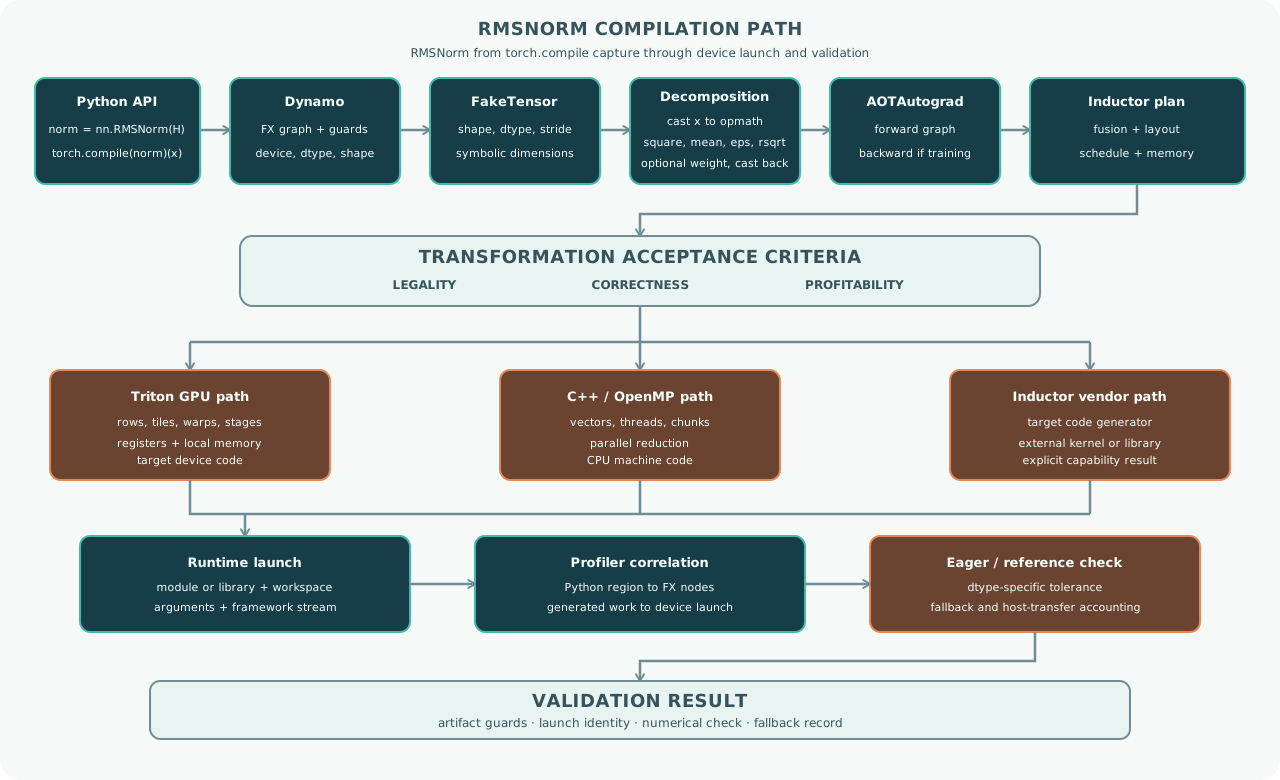
The path proceeds through eight stages:
- Capture the Python program. A user executes an instantiated
torch.nn.RMSNormmodule inside atorch.compileregion. Dynamo produces an FX graph and guards the facts used to specialize it. Those facts may include input device, dtype, rank, sizes, strides, module state, and the normalized shape. A failed guard can select a different cached graph or trigger compilation. - Establish metadata. FakeTensor execution propagates the output’s shape, dtype, device, and layout facts without allocating real input data. A symbolic batch or sequence dimension should remain symbolic if no later decision needs its value. The normalized width may need a guard when it controls a reduction schedule.
- Expose the computation. The backend can lower an RMSNorm operator directly, or decompose it into opmath casts, multiply, mean reduction, epsilon addition, reciprocal square root, broadcast multiply, affine multiply, and output cast. Either form carries the same semantic obligations. For training, AOTAutograd also needs a valid backward graph and saved-state policy.
- Plan fusion and layout. Inductor can consider folding the square into the reduction and applying the normalization and weight without materializing full intermediate tensors. A producer or consumer may join the region if aliasing, precision, and resource constraints allow it. Generated code determines whether the reduction and epilogue share one kernel.
- Choose a compiler integration. Current Inductor paths commonly generate Triton for supported GPUs and C++ with OpenMP for CPUs. An accelerator that integrates with Inductor can add target code generation or lower a region to an external kernel or vendor library. A custom Dynamo backend is a separate route: it receives the FX graph and returns an equivalent callable directly, bypassing Inductor for that region. Each boundary needs explicit capability and failure reporting.
- Choose tiles and resources. The schedule selects a one-pass or multi-pass reduction, vector width, rows per program, lane assignment, local-memory use, register budget, and launch geometry. Normalized width, alignment, dtype, available SRAM, and occupancy affect the choice. Bounded autotuning may choose among legal variants.
- Launch through the runtime. The wrapper loads a generated module or resolves a library entry point, obtains workspace, binds data pointers, strides, shapes, and scalars, selects the framework stream, and submits the launch. Its cache key must include the guards and target properties that made the artifact valid.
- Validate and attribute execution. Profiler data should connect the Python region and FX nodes to the generated kernel or external call and then to the device launch. Compare compiled results with eager PyTorch and an independent higher-precision reference across dtypes, shapes, strides, zero and extreme values, explicit and default epsilon, affine modes, and gradients where promised. Use a documented tolerance per dtype. Record graph breaks, recompilations, host transfers, and fallbacks. Treat silent eager execution as a failed compiler-path test.
Intermediate representations and lowering stages
A compiler uses several representations to separate concerns:
- A graph representation preserves tensor operations and model structure.
- A loop or tensor-program representation exposes iteration, fusion, and layout.
- A tiled representation maps work to blocks, lanes, matrix fragments, and memory spaces.
- A target representation exposes legal instructions, address spaces, and calling conventions.
- Machine code commits register allocation, scheduling, encoding, and relocation.
MLIR calls the movement between such levels dialect conversion. A conversion target defines which operations and types are legal; rewrite patterns and type converters turn illegal forms into legal ones. LLVM’s target layer performs the same kind of work closer to the instruction set: legalizing types and operations, selecting instructions, allocating registers, scheduling, and emitting code.
Tensor-level optimization can remain shared across devices. Target-specific layers handle matrix instruction selection and memory-space mapping for each instruction set and memory hierarchy.
Legality, correctness, and profitability
Legality: the target can represent the transformed program. Correctness: the transformed program preserves PyTorch’s observable behavior. Profitability: the measured benefit includes conversions, launches, workspace, and compile cost. Accept a compiler decision after all three checks pass.
Legality asks whether the proposed form satisfies target constraints:
- Are dtypes and vector widths legal?
- Is local memory within the device limit?
- Do barriers cover every producer and consumer?
- Can dynamic dimensions satisfy tile and alignment constraints?
Correctness asks whether the legal form still means the same thing:
- Does a fused region preserve mutation, alias order, and exception behavior?
- Are reduction order, accumulation dtype, rounding, and special values within the numerical contract?
- Does a layout change preserve every visible stride, view, and copy obligation?
- Does specialization cover its guards without miscompiling other inputs?
Profitability includes the costs around the kernel. Cost models estimate memory traffic, occupancy, instruction throughput, launch overhead, layout conversion, workspace, transfer overlap, and library performance. Measure important choices with autotuning within bounded search spaces, and retain the unfused or library path when measurements favor it.
Report legality failures with the violated constraint, correctness failures with a reduced reproducer, and profitability failures with the compared alternatives and measurements.
Layout planning across a graph
Tensor programs often admit several physical layouts. Layout affects coalescing, matrix instruction compatibility, vectorization, communication, and whether a transpose becomes metadata or a copy. Choosing it independently per operator can insert conversions that dominate the graph.
Layout planning crosses fusion and sometimes distributed sharding. A producer may accept a locally inferior layout because it is the consumer’s native form. A collective may operate on a shard layout that changes the next kernel’s tile. Compiler and library interfaces should carry layout descriptors explicitly across this boundary.
Runtime integration for generated code
After lowering, the backend must compile or assemble target code, load it, allocate workspace, bind constants, launch it on the right stream, and preserve errors and profiling identity. Ahead-of-time compilation moves some of that work out of the request path. JIT compilation can specialize more aggressively. The runtime contract applies to artifacts from either mode.
Cache correctness depends on guards, target capability, compiler build, options, and tuning results. Cache operations need atomic publication and corruption handling because many workers may compile the same artifact concurrently.
Compiler diagnostics and reproducers
Diagnostics should answer:
- Where did the first graph break occur?
- Which guard caused recompilation?
- Which decomposition introduced an unsupported primitive?
- Which pass changed the result?
- Why was a fusion rejected or selected?
- Which layout conversions were inserted?
- What target constraint made an operation illegal?
- Which generated kernel, cache key, and source graph produced a device fault?
Compiler developers need pass-by-pass IR dumps. Users need a compact causal report and a command that produces a complete reproducer. MLIR’s pass infrastructure includes timing, instrumentation, failure signaling, and crash reproducers. Accelerator compilers should expose equivalent timing, instrumentation, failure reports, and crash reproducers.
Compiler backend qualification
A compiler backend is ready to claim support when it passes:
- Eager-versus-compiled result comparison.
- Static and dynamic shape workloads.
- Mutation, aliasing, and view cases.
- Graph-break and fallback accounting.
- Training graphs where promised.
- Cache reuse and invalidation tests.
- Compiler crash and timeout containment.
- Performance tests that include compile cost and steady state.
Previous: Kernel Libraries. Next: Autograd, Precision, and Numerical Validation. Series index.
Sources: torch.compile; Dynamo core concepts; Fake tensor; torch.nn.RMSNorm; PyTorch RMSNorm native implementation; PyTorch compiler overview; custom compiler backends; profiling torch.compile; Inductor provenance tracking; PyTorch compiler troubleshooting; PyTorch compiler FAQ; MLIR dialect conversion; MLIR pass infrastructure; LLVM target-independent code generator.