
Part 3 of Building Software Support for a New AI Accelerator. The driver and runtime expose hardware as a process-scoped resource with memory, queues, synchronization, errors, and observable state.
Driver and runtime responsibilities
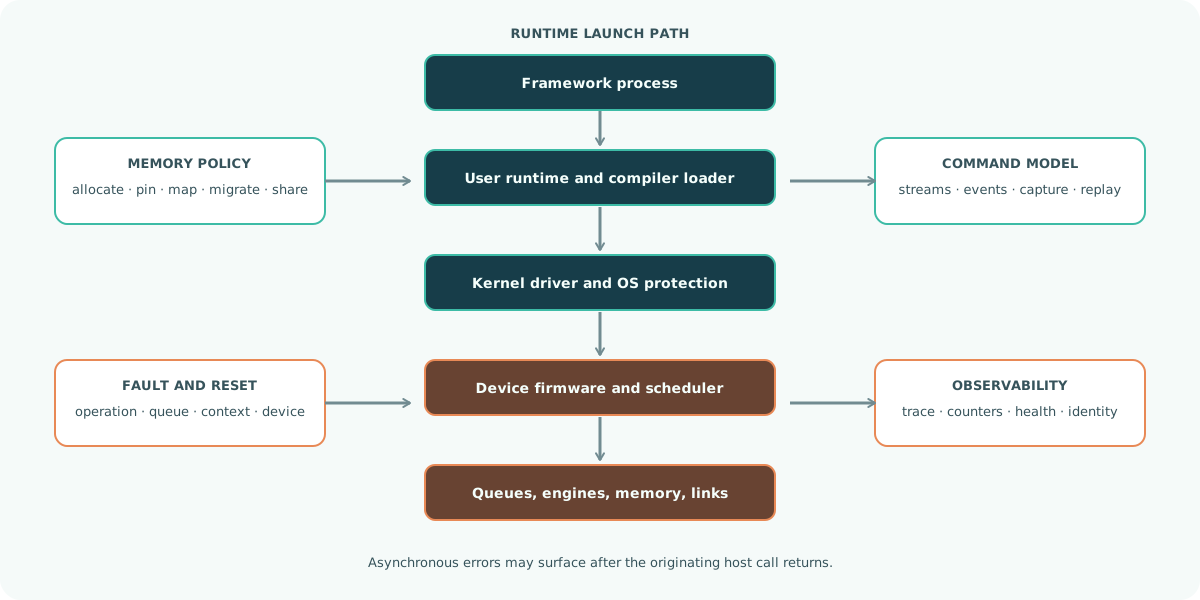
The operating system cannot hand a user process raw ownership of a large shared device. It needs a kernel driver to enumerate hardware, establish protection, manage interrupts and address translation, coordinate resets, expose telemetry, and mediate privileged operations. Device firmware often owns boot, scheduling, power, link management, or low-level recovery. A user-space runtime exposes allocation, queue, event, module, and kernel-launch APIs over those mechanisms.
This boundary limits privileged code and separates kernel and user-space release cadences. Kernel components need narrow, stable interfaces and cautious update paths. Firmware can change behavior behind a stable host ABI when its compatibility rules are explicit.
Device lifecycle and identity
The runtime must answer basic questions consistently:
- Which devices are visible to this process?
- Which physical package, partition, NUMA node, and fabric endpoint does each logical device represent?
- Which driver, firmware, and ISA versions are active?
- Which capabilities does the runtime report directly?
- Can the process create multiple contexts, and what resources do they share?
Stable identity matters for cache keys, telemetry, scheduling, and recovery. A
framework index such as device:1 identifies a device inside one process.
Correlating a retired memory page, a distributed rank, and a service incident
across reboots requires a stable physical identity.
Initialization also needs a clear failure model. Missing firmware, an unsupported driver, a partition already owned by another tenant, and a device in reset are different conditions. Collapsing them into “no accelerator available” sends users to the wrong team.
Command submission
Most accelerator work is asynchronous. A host thread records commands into one or more queues, submits them, and continues. The device consumes those commands when dependencies are ready. Streams or queues express ordering; events connect work across queues and give the host a completion point.
The contract needs precision:
- Operations in one stream usually have an ordering relation. Work in different streams may overlap unless an event or resource dependency connects them.
- A host API can return before a kernel starts. Errors may therefore surface at a later synchronization point.
- Memory reuse must wait for device completion. Host call return can precede device completion.
- Graph capture and replay require stable command, memory, and synchronization behavior across invocations.
- Priority or preemption claims need a defined granularity and worst-case delay.
Frameworks build eager execution, autograd scheduling, distributed overlap, and serving runtimes on these rules. A vague stream contract produces races that appear several layers above their cause.
Memory classes and placement policy
An allocation API hides physical pages, virtual addresses, residency, mapping, pinning, migration, and lifetime. The runtime generally needs several allocation classes:
- Device-local allocations for high-bandwidth access.
- Host allocations pinned for asynchronous transfer.
- Shared or unified allocations when supported by the platform.
- Peer-visible allocations for scale-up communication.
- Importable or exportable memory for graphics, media, networking, or another process.
Framework allocators cache blocks because device allocation is expensive and synchronization-sensitive. The cache introduces its own contract: reserved versus live bytes, fragmentation, stream-safe reuse, out-of-memory behavior, statistics, and a way to release unused blocks. PyTorch’s device-agnostic accelerator APIs now include memory counters and cache-management hooks because these are user-visible parts of the backend.
Virtual or unified memory hides explicit copies in source code while placement and migration costs remain. Oversubscription trades capacity for page-fault and transfer latency, which the profiler and runtime should report.
Modules, kernels, and caches
The runtime loads compiled device code, resolves symbols, validates target capabilities, allocates constant or executable memory, and launches entry points with arguments and shared-memory requirements. JIT compilers add a persistent cache whose identity may include:
- Source or graph hash.
- Compiler and framework builds.
- Target architecture and stepping.
- Driver or firmware compatibility boundary.
- Dtypes, shapes, layouts, specialization guards, and tuning result.
- Environment options that alter numerics or code generation.
Omitting a compatibility input can execute stale code. Including irrelevant inputs increases recompilation and startup cost. Cache design affects correctness and startup performance.
Faults, RAS, and reset scope
Reliability, availability, and serviceability begin in hardware and firmware, but the runtime carries their meaning to the application. Useful fault records identify the device, engine, queue, process, virtual address where safe, memory bank or link, severity, correction status, and reset scope.
Recovery depends on which state remains valid:
| Fault scope | Typical software consequence |
|---|---|
| One operation | fail the call; later work may continue |
| Queue or stream | cancel dependent work; rebuild the queue |
| Context | invalidate allocations and compiled module handles |
| Logical device or partition | quarantine and recreate the worker |
| Physical package or link domain | drain peers; reset or replace the node |
The exact mapping is device-specific. The requirement is that it be documented and testable. Distributed systems need it to decide whether to retry a request, restart a rank, or terminate the job.
Isolation and virtualization
Multi-process service requires address-space isolation, command validation, resource accounting, denial-of-service controls, and safe context teardown. Partitioning and virtual-device features add scheduling and quality-of-service questions: which caches, memory channels, copy engines, media blocks, and fabric links are dedicated or shared?
Containers continue to share the host kernel and device driver, so the driver remains a security and compatibility boundary. Packaging must constrain the user-space stack to a compatible host stack, and orchestration must limit visibility to the intended devices and capabilities.
PyTorch integration points
A framework backend maps these runtime mechanisms into device guards, streams, events, memory APIs, generators, hooks, profiling collectors, and Python-visible device management. It also needs lazy initialization, thread-local current-device and current-stream state, multiprocessing rules, and safe shutdown.
PyTorch’s accelerator integration guide provides an official out-of-tree reference called OpenReg and separates runtime integration from operator registration. Stream ordering and allocator lifetime require separate tests from operator correctness.
Process creation and runtime initialization
fork duplicates a process address space while leaving initialized runtime state
tied to the parent. The child can inherit Python and C++
objects that refer to a context, allocator pool, command queue, event, driver file
descriptor, background thread, or locked mutex created in the parent. Treating
those objects as live child state can deadlock, corrupt allocator accounting, or
submit work through a context owned by another process.
The safe default for accelerator workers is spawn or forkserver. Initialize the
backend inside each child, select its device there, and create process-local
streams, generators, allocator state, and library handles. Keep the parent free of
runtime initialization before workers are created. This restriction includes
availability checks: PyTorch notes that an accelerator availability query usually
initializes enough runtime state to prevent a later safe fork. A backend can offer
a fork-safe discovery path, but discovery and runtime initialization must remain
separate contracts.
The runtime also needs a defined response when a process identifier changes after
initialization. A backend can reject every device call with an error that names the
pre-fork initialization and recommends spawn. A backend that
supports child reinitialization must invalidate all inherited device objects,
reopen its driver connection, rebuild contexts and allocator state, and document
which host objects remain usable. Copied device handles must fail explicitly unless
the backend performs full child reinitialization.
Multiprocessing tests should cover fork before initialization, fork after
initialization, spawn, forkserver, repeated child creation, child crashes, clean
child exit, and continued parent operation. Add DataLoader workers and distributed
launchers because they expose initialization order that a small runtime test can
miss.
Runtime bring-up sequence
- Enumerate and identify one device.
- Allocate, map, copy, and free memory under stress.
- Submit a no-op and observe completion.
- Launch a small kernel and verify arguments and results.
- Exercise multiple queues and event dependencies.
- Add memory statistics, profiler correlation, and fault records.
- Stress process exit, crashes, resets, and repeated initialization.
- Add peer access, partitions, and multi-process isolation.
Validate these behaviors with a small runtime test suite and command-line diagnostic before framework integration.
Previous: The Hardware-Software Contract. Next: Tensors, Dispatch, and Operators. Series index.
Sources: PyTorch accelerator integration; torch.accelerator; PyTorch accelerator hooks; PyTorch accelerator semantics; PyTorch multiprocessing best practices; CUDA Programming Guide; CXL specification and resources.