
Part 4, the deep one. What MAX is and where it sits among NVIDIA’s stack and the open-source engines; my read on it as an in-process runtime; and the experiment that answers the Mojo question - compiling Ignis’s refund policy into the decoder two ways, which is where “is Mojo a peer in the graph or just a wrapper?” gets an answer.
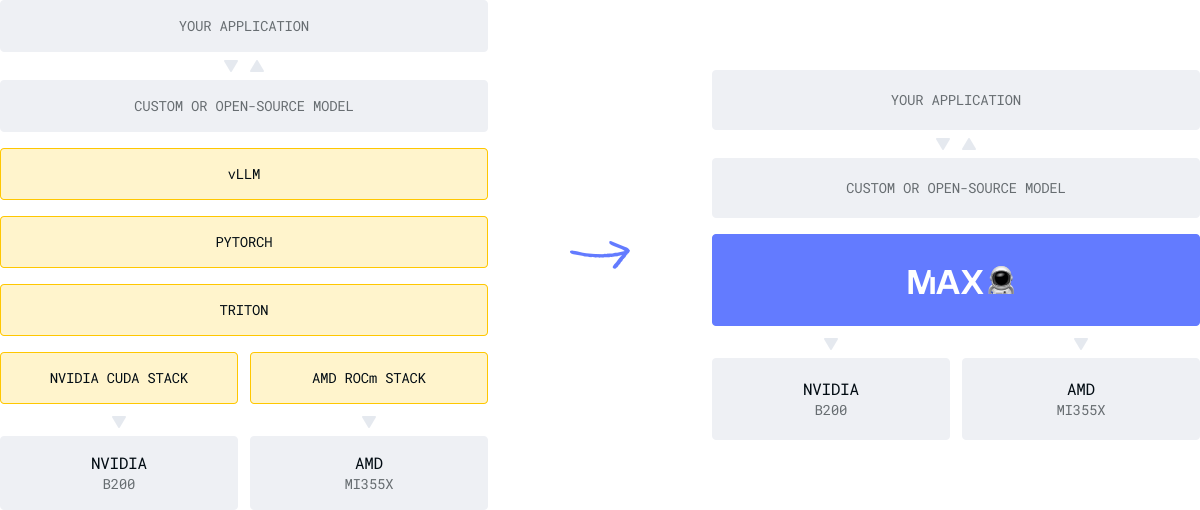
MAX and the MAX stack graphic are trademarks/assets of Modular Inc.; shown here for identification.
What MAX is
MAX is unusual in bundling several layers that other vendors ship as separate products. When you say “MAX,” you’re naming at least four things at once:
- A graph compiler (MLIR-based - Modular was founded by Chris Lattner, who created MLIR) that lowers a model to optimized kernels across hardware.
- An LLM serving/pipeline engine - paged KV cache, prefix caching, continuous batching, the
max.pipelinesAPI Ignis calls into. - A kernel-authoring language - Mojo, for custom ops (
@compiler.register/ops.custom). - A portability promise - the same stack on NVIDIA and AMD, deliberately breaking CUDA lock-in.
That bundling is the key to understanding both its competitors and its character.
New to MAX? A five-minute primer
If you’ve already served a model with MAX, skip to Is there a MAX from NVIDIA?. This section gets a newcomer oriented.
What it’s for. MAX (Modular’s inference platform) takes a model - typically a Hugging Face checkpoint like Qwen/Qwen3-8B - compiles its computation graph to optimized kernels, and runs or serves it fast, on CPU or NVIDIA or AMD GPUs from the same stack. Think “the engine that an LLM endpoint runs on,” in the same family as vLLM or TensorRT-LLM, but portable across vendors and with Mojo as its kernel language.
A few terms, plainly. A model turns text into tokens (sub-word chunks) and generates one token at a time. Each step attends over all previous tokens; to avoid recomputing that, the engine stores per-token key/value vectors in a KV cache. Prefix caching reuses the KV for a shared prefix across requests - so in a multi-turn chat, the unchanged history isn’t re-processed every turn. Paged attention is the memory scheme (à la vLLM’s PagedAttention) that makes that cache efficient. These aren’t trivia: for an agent that re-sends a growing conversation every turn, prefix-cache reuse is most of the performance story, and it’s the number Part 2 measures.
The simplest way to use it - serve an OpenAI endpoint. This is the path Modular leads with and most people start on:
pip install modular          # or: pixi add max
max serve --model-path Qwen/Qwen3-8B
# now you have an OpenAI-compatible server on localhost:8000:
curl localhost:8000/v1/chat/completions -d '{
  "model": "Qwen/Qwen3-8B",
  "messages": [{"role": "user", "content": "hello"}]
}'
Because the API is OpenAI-shaped, your existing client code (the openai SDK, LangChain, whatever) points at it unchanged. The model runs in its own process; you talk to it over HTTP.
The way Ignis uses it - in-process Python. Under the server is a Python library, max.pipelines. You can load and drive a model directly, no HTTP, no separate process:
from max.pipelines import PIPELINE_REGISTRY, PipelineConfig
# (the real PipelineConfig is more nested - model path, quantization, device)
tokenizer, pipeline = PIPELINE_REGISTRY.retrieve(PipelineConfig(...))
async for output in pipeline.generate_async(request):
    ...   # output.tokens, and output.num_cached_tokens - the real cache count
This is the seam Ignis crosses from Mojo via std.python. It’s “more in-process” than max serve (the model runs inline in the calling thread). The payoff that REST genuinely can’t match is the model’s exact emitted tool-call bytes: an OpenAI endpoint hands you a normalized tool_calls object, having already parsed and discarded the raw <tool_call> text Ignis replays - inline, you keep the bytes. The cache number rides along for free too (MAX’s num_cached_tokens, read directly rather than depending on a server to expose it).
The deeper layers are where this part is headed. MAX Graph is the symbolic-graph + compiler layer; Mojo custom ops (@compiler.register / ops.custom) let you drop your own compiled kernel into that graph; and the sampler exposes hooks (SamplingParams.logits_processors) and production constrained decoding (an llguidance grammar engine). Those four are exactly the parts the two gates below are built from - and Qwen3 here is a “thinking” model, so it emits a <think>…</think> preamble the harness strips, a small wrinkle worth knowing before you read live output.
Mojo, the kernel language. The orchestration surface above (max.pipelines, max serve) is Python - but the kernels under it are written in Mojo, and custom ops are how you author new ones. That split (Python to drive, Mojo to compute) is the single most important thing to hold onto, and the rest of the series turns on it.
What the official docs claim (and why it matters here). Modular describes MAX as a high-performance AI serving framework that exposes an OpenAI-compatible endpoint and runs native MAX and PyTorch models across GPUs and CPUs - explicitly “no CUDA required” and free of vendor lock-in. Out of the box it advertises:
- an OpenAI-compatible REST API serving 500+ Hugging Face models;
- graph-compiler optimizations, quantization, continuous batching, prefix caching, and speculative decoding;
- function calling and structured output - the very feature Ignis rides for the airtight grammar gate below;
- LoRA adapters, and custom kernels authored in Mojo.
You install it with pip install modular (the max CLI) or run a sub-1 GB Docker container. The thing to notice: nearly every bullet there is a primitive Part 2 found already built - which is precisely why the harness’s job turned out to be binding these primitives together; the hard inference work was already built.
Is there a MAX from NVIDIA or AMD?
A colleague, watching me wire Mojo into the in-process pipeline, asked the obvious question: isn’t there already an equivalent from NVIDIA, AMD, or anyone? The answer depends on which layer you mean - no single product covers all four.
The short version: NVIDIA has the closest answer, but it is vendor-locked. AMD has many of the ingredients, but not a single MAX-like platform.
| MAX layer | NVIDIA answer | AMD answer |
|---|---|---|
| Integrated inference platform | Closest: TensorRT + TensorRT-LLM + NIM/Triton + CUDA | No single equivalent: ROCm + MIGraphX + vLLM/SGLang/TGI + HIP/CK |
| Graph compiler / engine | TensorRT | MIGraphX / Torch-MIGraphX |
| LLM runtime / pipeline | TensorRT-LLM | vLLM, SGLang, TGI on ROCm |
| Serving / OpenAI-compatible endpoint | NIM, Triton Inference Server, TensorRT-LLM server | vLLM/SGLang/TGI servers on ROCm |
| Custom ops / kernel authoring | CUDA C++, CUTLASS, cuDNN, Triton language | HIP C++, Composable Kernel, rocBLAS/MIOpen, Triton-on-ROCm |
| Portability story | NVIDIA-first, CUDA-centered | AMD-first, ROCm-centered |
| Does it answer MAX? | Closest answer, but NVIDIA-first | Parts, not a MAX-shaped product |
Triton appears twice here: Triton Inference Server is NVIDIA’s serving system; Triton the kernel language is the Python-embedded GPU DSL often compared with Mojo. The point of the table is not that NVIDIA or AMD lack the pieces. It is that MAX turns stack assembly into one product surface: the graph compiler is not just an export step, serving is not a separate deployment layer, the LLM scheduler primitives are available directly, and custom kernel work fits into the same mental model. On AMD especially, the equivalent path is assembled from framework, ROCm, compiler, and kernel libraries. MAX packages those scattered layers under one portable compiler/runtime/serving/kernel stack.
The vendor-neutral engines are arguably MAX’s most direct functional rivals for what Ignis uses it for - in-process inference with paged/prefix-cached KV:
- vLLM - originated PagedAttention (the paged-KV idea), continuous batching, prefix caching, OpenAI API; runs on NVIDIA/AMD/Intel. The single closest substitute for MAX’s serving layer.
- SGLang - RadixAttention for prefix caching, strong throughput and structured generation.
- TGI, LMDeploy, DeepSpeed-FastGen - same category. llama.cpp / GGML - the lightweight portable end.
The compiler peers are MAX’s deepest, least-crowded identity: IREE (MLIR-based, multi-backend - the closest sibling), Apache TVM, OpenXLA / XLA. The honest summary:
- the serving engine Ignis calls → vLLM / SGLang (and TensorRT-LLM + NIM are NVIDIA’s locked-in version);
- the compiler/portability ambition → IREE / TVM / OpenXLA;
- Mojo-as-kernel-language inside a portable runtime → no true peer. A full systems language that also targets accelerators is Modular’s genuinely unusual bet.
There isn’t a clean “MAX from NVIDIA” or “MAX from AMD” because MAX’s whole identity is the refusal to be from one vendor - fusing compiler, portable runtime, kernel language, and serving into one stack. Which is exactly why it’s the right substrate for an experiment about proximity.
What MAX gave Ignis
As an in-process runtime, MAX delivered more than I expected, and kept delivering things I’d assumed I would have to build:
- A genuine in-process path via
PIPELINE_REGISTRY.retrieve(...)+generate_async(...)- the model runs inline in the calling thread, no worker subprocess. - Real cache telemetry -
num_cached_tokensper request, page-granular and honest (the subject of Part 2). - Custom ops - compiled Mojo as a node in the model’s own graph.
- A per-request sampler hook -
SamplingParams.logits_processors, a callback handed the raw logits each decode step. - Production constrained decoding - llguidance grammar enforcement already wired into the sampler graph.
- A tiered KV connector - device→host→disk offload that survives a process restart.
- More than one pipeline per process - the same
retrieve(...)withtask=PipelineTask.EMBEDDINGS_GENERATIONloads an embedding model alongside the LLM, one argument away. - Speculative decoding - a standalone draft/target pipeline behind a config flag.
The middle of that list is what the two gates below are built from. The last two come back at the end.
Compiling the policy into the decoder
If you want to know whether Mojo is a real participant in the model’s computation or just polite host-side glue, make it do something that has to happen during token selection. So I took Ignis’s signature policy - the order-id-bound refund gate - and tried to move it from host-side control flow into the decoder itself. Can the model be made structurally unable to call issue_refund_quote until an exact, matching confirmation opens it?
I built it twice. The gap between the two versions shows exactly where hand-written Mojo stops being enough and you have to fall back on MAX’s built-in machinery.
Gate one - a Mojo custom op, from scratch
The first version (examples/graph_policy_gate) is a Mojo custom op compiled into a MAX graph - the smallest real thing, an elementwise additive logit mask:
@compiler.register("gated_logits")
struct GatedLogits:
    @staticmethod
    def execute[target: StaticString](
        output: OutputTensor,
        logits: InputTensor[dtype = output.dtype, rank = output.rank, ...],
        mask:   InputTensor[dtype = output.dtype, rank = output.rank, ...],
        ctx: DeviceContext,
    ) raises:
        # the whole policy enforcement, as a graph node: out[i] = logits[i] + mask[i]
The host computes mask from the exact gate (0.0 to allow, −1e30 to forbid); applying it in-graph drives the refund token’s logit to −∞. Two things I braced for and didn’t get: it doesn’t need fn (MAX 26.4’s custom-op API is authored with def, because in 1.0 beta def carries the strict semantics fn used to - and stepping down to an fn-era Mojo would pin an older, incompatible MAX), and the published doc import paths are wrong for this build (the real ones are extensibility, std.gpu.host, std.utils.index; the source of truth is Modular’s own add_constant.mojo).
It compiles, runs in-process (GATE_OP_DEMO_OK, 4/4 turns), and - wired into a live Qwen3’s loop through logits_processors - runs inside the real sampler each decode step. So yes: a Mojo custom op is a genuine peer in the graph. That half of the question is settled.
But the from-scratch gate is naive token-id suppression, and the model proved it. Forcing the tokenizations of issue_refund_quote to −∞ doesn’t block every byte-equivalent path to the same meaning. Closed, the model routed around it:
GATE CLOSED (numpy suppressor)      -> tool = issue_request_for_a_quotation
GATE CLOSED (gated_logits Mojo op)  -> tool = issue_deferred_payment
An earlier version got beaten by literally issue_REFUND_QUOTE - uppercase tokenizes to different ids. You widen the set; the model finds another synonym. It’s a losing game for a principled reason: masking token ids can never enumerate every string that means the forbidden thing. So the scorecard for gate one: it proves a Mojo op can author, compile, and execute enforcement as a graph node; it’s no speedup (routing a vector add through a graph is slower than host code); and it isn’t airtight.
Gate two - riding MAX’s own grammar engine
Airtight enforcement is a different mechanism - grammar or FSM-constrained decoding - and gate two (examples/grammar_policy_gate) is the admission that I shouldn’t write that myself. MAX already ships it: an llguidance bitmask applied inside the sampler graph (ops.where(bitmask, logits, -inf)). I reach it through the same in-process pipeline by attaching a response_format JSON schema whose tool-name enum is the policy:
- gate closed →
enum: ["get_order_status"]→ llguidance makes any token path spellingissue_refund_quoteimpossible to produce. - gate open →
enum: ["get_order_status", "issue_refund_quote"].
The decision is still Ignis’s (the same is_confirmation + order-id binding); MAX enforces it, and the forbidden direction is now airtight (GRAMMAR_GATE_OK, on an H100). The synonym evasion is structurally gone. It cost a pile of warts I only found by building it: GPU only (enable_structured_output raises on CPU); the bare in-process path needs max_batch_size=1; greedy (top_k=1) required (sampling can pick a padding token above the grammar’s vocab range and abort llguidance); enforcement is guaranteed only up to the policy-critical field (the matcher rejects EOS in a non-accepting state and self-disables for the JSON tail - fine for a name-gating policy, but you have to know it); and it emits raw JSON instead of Qwen’s Hermes <tool_call> wrap, so it doesn’t feed the existing HermesToolCodec.
The answer to peer-or-wrapper
Side by side, the two gates turn the question into something more precise than either word:
Mojo is a real peer in the graph for authoring enforcement - a custom op compiles in and runs inside the live sampler, proven. But airtight constrained decoding is a solved problem MAX already owns, and the honest move is to drive that engine instead of reimplementing it.
Mojo is the right tool for small, bespoke decision logic you want compiled next to the model; MAX’s grammar engine is the right tool for airtight structural constraints. Neither pure wrapper nor full co-author of the decoder - a peer for the part worth authoring by hand, a disciplined client for the part that isn’t.
The frontier kept being MAX’s - except one thing
This is the lesson that kept repeating, and it moves where the real work is. Each time I reached for something that felt like the Mojo-native edge, MAX was already standing on it:
- The agentic loop? The cookbook’s
max servepattern. - Enforcing a policy inside generation?
SamplingParams.logits_processors, one file away. - Fusing a custom op into the sampler? The sampler is already its own graph that masks logits.
- Grammar-constrained tool decoding? A full conditional tool-call grammar, already shipped.
Four times, a “Mojo frontier” turned out occupied by Python-first MAX. Hand-rolling any of them would have produced a worse copy of something already there. So the open work for a harness like this lies elsewhere - in the part MAX deliberately leaves alone.
There’s exactly one such part. MAX’s tiered connector persists KV blocks to disk, but it keys them by a hash of the token prefix, not by any session id - by design, the engine has no notion of a conversation, and shouldn’t. So the binding is the harness’s job: persisting the messages isn’t enough, it has to re-render its timeline to byte-identical tokens so the prefix hashes to the same key and the on-disk KV is actually reused. That re-render reproduces the exact token prefix the KV was keyed on, and a fresh process warm-starts on it:
SESSION_RESUME_OK kv_warmstart_tokens=1152
A separate process, 1152 tokens of the restored conversation served from disk, the model continuing. It rides the regular TieredConnector plus a post-generation flush that works around three real connector bugs (an offload off-by-one for single-batch sessions; an async D2H event not ready when sync() checks it; metadata not flushed after wait_for_writes()). And the whole thing rests on the render staying byte-identical between save and resume - if the system prompt or formatting drifts, the warm-start vanishes silently, with correct output and lost reuse. Which is why that invariant has model-free CI guarding it.
The pattern, tested twice more
After that writeup I pushed twice more, and both pushes sharpened the lesson rather than overturning it.
In-process RAG: a second pipeline is a one-argument change. The open risk was that process-global Modular context - the same one that crashes mojo run. Would a second pipeline collide with the first? It doesn’t. PIPELINE_REGISTRY.retrieve(config, task=PipelineTask.EMBEDDINGS_GENERATION) loads an embedding model (mpnet, CPU) beside the Qwen3 LLM (GPU) in one process, verified live on an H100 with both generating. One trap worth its own sentence: MAX’s pooled embeddings are not unit vectors (pool_embeddings=True mean-pools without L2-normalizing; I saw norms of 42/60/30), so Ignis normalizes at the Python boundary, which makes the Mojo-side dot product cosine similarity. And the division of ownership held exactly as the bet predicted: MAX runs both models; Mojo owns the index and the similarity kernel (Part 3 shows it). The “one thing MAX leaves alone” turns out to be a whole category: conversation state was the first member, application-side retrieval is the second.
Speculative decoding: advertised, shipped, and at this scale a measured loss. The feature list above advertises it, and it’s really there: a standalone draft/target mode where Qwen3-0.6B proposes k tokens and Qwen3-8B verifies them in one pass. But the path was unwalked enough that three bugs stood between retrieve() and a running pipeline: a Dim + TensorValue type error in the target’s logits graph (already fixed upstream; backported), the draft model being built from the target’s config (an 8B graph loading 0.6B weights), and the draft’s second step arriving one graph input short (a dropped draft_attention_dispatch_metadata). All three are patched in-harness and filed in docs/upstream-findings.md. Then the honest benchmark - one H100, greedy, three 256-token runs after warm-up: baseline 165.7 tok/s, spec k=2 141.6 tok/s. The arithmetic explains it: a k=2 cycle should cost about 9.7 ms of compute but measures about 15.2 ms - roughly 5.5 ms/cycle of host-side overhead in MAX’s spec pipeline - and break-even at k=2 needs about 2.4 accepted tokens per cycle where the real pair delivers 2.15. The synthetic-acceptance ceiling (1.8× at k=5) says the machinery wins where target steps dwarf the fixed overhead - on bigger, slower targets than 8B. So it ships opt-in behind IGNIS_DRAFT_MODEL, off by default, with scripts/bench_speculative.py for pairs where the math changes.
Two refinements to the lesson, then. The parts MAX leaves alone are the application-side state and compute - conversations, retrieval indexes - and that’s where harness Mojo earns its keep. And “already shipped” doesn’t mean “already walked”: being in-process is what turned three upstream bugs from blockers into findings, and being metric-honest is what turned a speedup feature into a correctly-reported slowdown.
My verdict on MAX
As an in-process runtime, MAX is further along than its Python-first positioning suggests, and that’s the headline: compiled Mojo can already reach into the model’s compute today - a custom op runs as a node in the graph, on the live logits, in the decode loop. The obstacle was never that two compiled worlds can’t meet. What remains is narrower and specific: the orchestration API is Python. There’s no Mojo-native way to load Qwen3 and drive generate, so the loop runs from CPython even while a Mojo kernel works inside it. A documented, supported in-process MAX-from-Mojo API would remove the integration traps and the last layer of CPython at once.
The other thing to credit honestly: MAX’s instinct to ship the hard inference primitives (paged KV, prefix caching, logits hooks, llguidance grammar, tiered offload, multi-pipeline processes, speculative decoding) means a harness author should reach for them first - measuring before believing - and reserve Mojo for the bespoke edges and the application-level state and compute MAX leaves open: conversations, retrieval indexes, the similarity kernel. I don’t read any of that as a shortcoming in MAX. It’s the right division of labor, and finding it was half the value of the expedition.
Previous: Mojo, the Language. Next: My Journey. Series index.