
Part 4 of The Future of Agentic Engineering. How good work compounds into reusable assets, what stops it running away, and who gains.

Part 3 argued that humans need cadence control because agents run faster and longer than human attention. This part looks at the compounding effect: as you use agentic systems, your ability to build can grow, because every good loop can leave reusable assets behind. But no compounding process runs forever. This is about the limits, the winners, and the likely equilibrium.
The mechanism is conversion, not generation
Agentic work compounds when work improves the future work environment.
One run produces a fix. A better run produces a fix plus a test. A better one still produces a fix, a test, documentation, a decision record, and a reusable skill. Over time a team accumulates code, tests, prompts, skills, tools, runbooks, architecture records, and eval suites that make future work easier.
But compounding is bounded by review capacity, verification cost, context complexity, maintenance burden, budgets, risk tolerance, and the supply of valuable problems. The equilibrium is not infinite acceleration. It is a widening gap between teams that convert agent output into durable systems and teams that merely generate more artifacts.
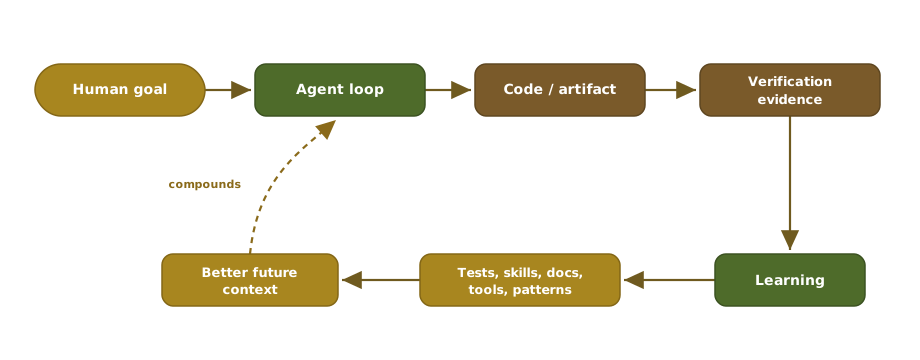
The critical step is conversion. If a successful run does not become a test, a skill, a standard, a reusable script, or a documented decision, the learning stays local and decays.
Sources of compounding advantage
Better context. Agents do better when the repo has clear structure, conventions, tests, and docs. Every architecture decision, setup note, fixture, and runbook improves their future context. Advantage to teams that keep systems readable.
Better verification. The stronger the test and eval environment, the more can be safely delegated. Fast CI, good fixtures, stable local setup, and meaningful integration tests let agents attempt more because failures are visible. Advantage to teams that invested in quality before AI, and to those now using AI to build the quality infrastructure they lacked.
Better skills and reusable loops. Repeated work packs into skills: release-building, dependency updates, security review, incident triage, API migration, UI polish, documentation refresh, data-backfill planning. Skills cut prompt variance and encode local standards. Advantage to teams that turn lessons into reusable workflows.
Better tooling and permissions. MCP servers, internal CLIs, dashboards, and structured tools let agents act on real systems without broad unsafe access. Narrow typed tools are more repeatable than free-form shell for many tasks. Advantage to teams with strong internal platforms.
Better human taste. Agents produce many options. Humans with product taste, engineering taste, and risk judgment select the right one faster, and good selections become standards and examples. Advantage to humans who can judge quality across domains.
Natural stabilizing factors
1. Human attention bandwidth. The first limit. More output means more review unless the system filters, summarizes, and verifies well. One human can start many runs but cannot deeply review all of them at once. Effect: parallelism gets capped by review bandwidth and trust in automated checks.
2. Verification cost. Some work has cheap ground truth - formatting, unit tests, type checks, dependency updates. Some has expensive ground truth - product-market fit, UX quality, security posture, strategy, legal interpretation, complex migrations. Effect: autonomy is highest where feedback is fast and objective, lower where judgment or real-world validation is required.
3. Maintenance burden. More code is not more progress. Research on AI coding tools shows gains are context-dependent, and some studies find experienced developers slowed down or carrying more review and rework. That is not proof AI coding is useless; it is evidence that generated work can move the bottleneck to maintenance. Effect: mature systems with high standards need stronger filters than greenfield prototypes.
4. Context and system complexity. As a codebase grows, the relevant context for any change gets harder to find. Agents miss hidden coupling, implicit product rules, migration hazards, and production history. Effect: architecture clarity and context curation become strategic assets.
5. Token, compute, and tool cost. Every run consumes inference, tool calls, storage, CI minutes, review time, and sometimes cloud resources. Unit costs may fall, but demand expands as capability expands. Effect: organizations manage agent work as a portfolio - cheap quick checks for routine work, deeper loops for high-value work, no run when the decision is not worth the cost.
6. Risk and governance. As agents gain tool access, they can affect code, data, infrastructure, customers, vendors, and compliance. NIST’s framing implies governance integrated into design, development, deployment, and monitoring. Effect: high-risk domains adopt agents through controlled pathways, not unlimited autonomy.
7. Valuable problem supply. Once easy automation and obvious product ideas run out, the bottleneck returns to understanding users, markets, constraints, and strategy. Agents generate implementations faster than humans discover what should exist. Effect: product discovery and domain knowledge stay scarce.
8. Organizational absorption. Change has to be absorbed: customers need onboarding, support needs docs, sales needs positioning, security needs review, finance needs cost visibility, operations need runbooks. Output the organization cannot absorb becomes churn. Effect: organizational learning rate becomes a ceiling on generation rate.
Who gains
Individuals
Higher advantage: people with strong product judgment and enough technical fluency to inspect work; engineers who design tests, tools, and architecture that agents can use; specialists who encode expertise into reusable skills, checklists, evals, and review gates; people with strong writing, synthesis, and decision-making habits; people who manage attention and cadence.
Lower advantage: people who outsource judgment to the model; people who measure output volume instead of validated outcomes; narrow specialists who cannot explain their standards or integrate across the lifecycle; developers who accept large generated diffs without understanding them.
Teams
Higher advantage: small teams with clear ownership, fast review, and strong tests; product teams close to users and able to validate quickly; engineering teams with internal platforms, CI, observability, and clean architecture; security-conscious teams that give agents safe tools rather than banning or ignoring them; teams that record decisions and promote workflows into skills.
Lower advantage: teams with ambiguous priorities; teams with weak tests and slow review; teams with large legacy systems and undocumented coupling; teams that treat AI as headcount replacement without redesigning process; teams that allow shadow AI without governance.
Organizations
Higher advantage: organizations with proprietary context, distribution, customer trust, and domain data; those that deploy agentic workflows inside their operating system; those with cultures of measurement and retrospection; those that can train workers across the lifecycle.
Lower advantage: organizations with fragmented tools and locked-away knowledge; those that reward visible activity over outcomes; those with approval bottlenecks that block iteration; those that underinvest in quality and then drown in generated work.
Who loses
The clearest losers are not “coders” as a class. They are roles and organizations that depend on scarcity of execution rather than quality of judgment. At risk:
- Boilerplate implementation as a standalone value proposition.
- Shallow project management that only moves tickets.
- Manual QA that never becomes test strategy or risk analysis.
- Documentation that restates the UI and never captures product understanding.
- Review that checks formatting but not behavior, risk, or maintainability.
- Outsourcing models based on labor hours rather than ownership of outcomes.
Many of these transform. The same QA role can become evaluation architect. The same project manager can become agentic-workflow designer. The same documentation owner can become customer-feedback intelligence lead.
The new equilibrium
1. Prototypes become cheap. First drafts, demos, and internal tools cost much less. “I can build a prototype” stops being a differentiator. Durable advantage moves to knowing which prototype matters, validating it, hardening it, distributing it, operating it, and improving it.
2. Production stays hard. Production software still needs reliability, security, migration safety, observability, support, documentation, and user trust. Agents help with all of it, but do not remove accountability. The equilibrium separates demo-speed from production-speed.
3. Human review becomes scarce. As output rises, expert review gets more valuable. Senior engineers, product leaders, security reviewers, and domain experts become bottlenecks unless their judgment is encoded into systems. The equilibrium rewards teams that scale expert judgment through tests, tools, skills, and standards.
4. Work moves toward smaller accountable teams. When execution is cheaper, large handoff-heavy structures lose some of their edge. Smaller teams with strong ownership cover more lifecycle surface with agents. Not one person replacing a company - smaller accountable units on agentic infrastructure.
5. Governance becomes productive, not just defensive. Good governance is not a blocker; it is what enables safe autonomy. Permissions, evals, audit logs, and release gates let more work happen with less fear. The equilibrium rewards governance embedded in tools rather than imposed after the fact.
Where this points
Compounding needs explicit mechanisms to be real:
- A skill registry for promoted workflows.
- A test and eval registry tied to requirements and risks.
- A decision-to-instruction path: when a decision repeats, convert it into guidance or automation.
- Metrics for generated output, accepted output, rework, review burden, and production incidents.
- Cost tracking for tokens, CI, cloud resources, and human review time.
- A governance model that distinguishes prototype, internal tool, user-facing feature, infrastructure change, data change, and production release.
Without this, agents create temporary acceleration but not compounding advantage.
Sources
- Measuring AI Ability to Complete Long Tasks
- Measuring the Impact of Early-2025 AI on Experienced Open-Source Developer Productivity
- AI-assisted Programming May Decrease the Productivity of Experienced Developers by Increasing Maintenance Burden
- AI and jobs: A review of theory, estimates, and evidence
- DORA Research: 2025 State of AI-assisted Software Development
- DORA: Choosing measurement frameworks to fit your organizational goals
- NIST AI Risk Management Framework
- OpenAI Codex: Agent Skills
- Model Context Protocol: Tools
- World Economic Forum: Future of Jobs Report 2025
Previous: Part 3 - Cadence and Mental Discipline. Next: Part 5 - Wellbeing, Sustainability, and Education. Series index.